Saturday, July 28, 2012

Almost Weekly Foodie Faves: A Friday Bloguette


Once upon a time, I thought I’d take up faux painting as a hobby. You know, be someone who paints faux finishes on walls or chairs and gets friends and neighbors to call her for fun projects. So I took a course. And I invited my friend, Barbara, to take the course with me.


It took place on a Saturday, so I got my husband to take care of the kids, and Barbara and I drove way out on Long Island and spent a full day learning all the techniques and variations on what you can do with those techniques. And we went home with a stack of poster boards that looked a lot like these, to remind us of what we could now achieve.


I never did another bit of faux painting. It turns out that it was less fun without a talented, knowledgeable friend to work with, and a large wall – or three or four – is a lot less fun than a 2-foot by 3-foot piece of poster board. So I am now what you might call a faux faux painter.

But one really great thing I got out of that class was a roll of cheesecloth. The pieces were all nicely cut into 2-foot squares – just the size you might want if you were applying paint by hand to a wall. Also, coincidentally, the size that’s just perfect for straining homemade ricotta. Or various types of soups or sauces. Or you could cut a piece in half and make a sachet d’épices (a small cheesecloth sack of herbs and spices) that you drop into a broth for seasoning.

I will admit that for a sachet, these little cheesecloth bags that you can buy (I get mine at Sur La Table) are really lots neater; and in the absence of cheesecloth, you can use a paper coffee filter or a couple of Bounty paper towels to strain the ricotta. But I cannot tell you how often I’ve been really happy I hadn’t used that giant roll of cheesecloth to paint a bunch of walls.


P.S. Barbara, for her part, has gone on to faux paint tables and chairs and bookcases and walls and even a garden rail. She has a website. She’s such a show-off.

Wednesday, July 25, 2012

The Kitchen Goddess says, “Make this salad.”


A writing workshop leader once told me, “In journalism, one is a sighting, two is a coincidence, three is a trend. Write about it.” So in the last couple of weeks, I’ve come across one particular item appearing on the menu at two nice restaurants I’ve been to. Then Julia Moskin, writing in the Dining section of last Wednesday’s New York Times, published a recipe by vegetarian blogger Michael Natkin, featuring that same ingredient: burrata cheese. That makes three for me, so I’m calling the trend.

It’s not a new cheese, but it’s definitely been in hiding. The first time I saw it on a menu, I didn’t know what it was, though it sounded like an Italian cheese. The second time I saw it, I decided to order it, and I’m pretty sure I heard the angels singing as I took my first bite.

Picture a mozzarella pouch about an eighth of an inch thick; the cheesemaker then stuffs the pouch with a mixture of fresh mozzarella “scraps” mixed with cream. So the texture on the inside is very loose – almost like that of cottage cheese. But I can promise you that the rich, buttery flavor is nothing like cottage cheese.

The burrata-making capital of the world is the Puglia region of Italy. And while it’s now made even in the U.S., nothing beats the Italians. So the most important point to make in buying burrata is that it should be fresh. Ask your grocer when it came in; “Today” or “Yesterday” are good answers.

Mr. Natkin, whose blog Herbivoracious (and book of the same name) is a tremendous site for vegetarian dishes, has an obvious knack for melding flavors and textures. Every part of the salad sounded good to me – the crispy shiitakes, the lemony olive oil, the crunchy julienne of snap peas, and the toasted pignolis. And of course the creamy burrata.

I bought the burrata this morning (it came in “yesterday”), and wanted to use it at its maximum freshness, so I made the salad for lunch. And I’m pretty sure neither my hubby nor I said more than two words to each other as we scarfed it down. Those two words would be “Oh, my.”

So now you have to try it. Trust me on this.

Kitchen Goddess note: Before you start slicing the shiitakes or stringing the sugar snap peas or washing the lettuce or toasting the pine nuts, get the lemon-infused oil going. You want to give it the maximum amount of time to get the oil nice and lemony.

Burrata with Shredded Sugar Snap Pea and Crispy Shiitake Salad
Adapted from Michael Natkin's Herbivoracious blog

Total time: 40 minutes

¼ cup extra virgin olive oil
1 lemon (Meyer if possible)
Vegetable oil for pan-frying (about ¼ cup)
5 fresh shiitake mushroom caps, sliced about ⅛-inch thick
Kosher salt
Salad greens
1 ball of burrata cheese, about 4 ounces, at room temperature
½ cup sugar snap peas, strings removed and thinly sliced lengthwise (to a slaw-like texture)
Maldon salt or other flaky finishing salt
2 teaspoons toasted pine nuts [see Kitchen Goddess note below]


1. Start by combining the olive oil with the zest from the lemon. Using a rasp, zest the lemon over the olive oil so that the natural oils released from the skin also end up in the olive oil. You won’t use all the oil in this recipe, but it’s delicious and will keep in the refrigerator. (You can pour it over fresh tomatoes with basil or use it as a dip with crusty French bread or make a nice lemony vinaigrette. Use your imagination.) After zesting, juice the lemon into a separate small bowl.

2. Heat the vegetable oil in a large skillet over medium-high heat until it shimmers. Add the mushrooms (carefully – there’s lots of water in mushrooms, and they’ll spatter), and sprinkle with a pinch of kosher salt. Cook until deep golden brown on one side, then flip and cook the other side just long enough to get some color (about 3 minutes total). Using a slotted spoon or spatula, move the mushrooms to paper towels to cool.

3. Strain the lemon zest from the olive oil. Arrange a few lettuce leaves on each serving plate and place the burrata in the center. In a small bowl, toss the sugar snap peas with a generous tablespoon of the lemon-infused olive oil, 2 teaspoons of the lemon juice and ¼ teaspoon of the Maldon salt. (I know, there’ll be lemon juice left over, too. Try adding it to the lemon oil with your favorite herbs for a nice salad dressing.) Pour the contents of the bowl over the burrata, and sprinkle the shiitakes and the pine nuts on top. Add a few more flakes of Maldon salt and a couple of fresh grinds of pepper. Serve immediately, while the snap peas and mushrooms are still crispy.


Yield: 2 servings as an appetizer at dinner or a luncheon entrée.


More Kitchen Goddess notes: 1. Toasting pignoli nuts is easiest in a dry skillet over medium-low heat for about 5 minutes. Shake the skillet frequently to ensure even browning. 2. Maldon salt is the latest candidate in the trendy salt movement. It’s a delicately flaked sea salt from England, and – surprise! – it’s expensive. If you have some, great. If not, I’d go with kosher salt, which is coarser but better than table salt. 3. The burrata I found was 8 ounces, so I cut it in half, served 2 ounces to each plate, and will eat the rest tomorrow. 4. With a nice piece of toasted French or Italian bread, this salad makes a really nice light lunch.

Friday, July 20, 2012

Almost Weekly Foodie Faves: A Friday Bloguette


I’ve always had a sweet tooth. So it should not be a surprise that I’m extremely fond of dessert wines as a way to top off a meal. You can serve them with dessert, or they might be the dessert itself, accompanied by bowls of nuts and dark chocolates or a cheese platter. Kitchen Goddess note: The only consideration is the sweetness – the dessert wine should always be sweeter than the dessert, or the wine will taste dull. So with very sweet desserts, just serve coffee and tea.

In the United States, a dessert wine is legally defined as any wine over 14% alcohol by volume, which includes all fortified wines, such as port and madeira; but most people think of dessert wines in a range from German wines like a late-harvest Gewürztraminer or Riesling, to sweet sparkling wines, to Sauternes or ice wine, my personal favorite, which is made from grapes that have been left on the vine to freeze.  A Sauterne is mellower, like a sunny day in springtime; while a good ice wine – served very cold – has a bracing sweetness that reminds me of the air at the top of a mountain.

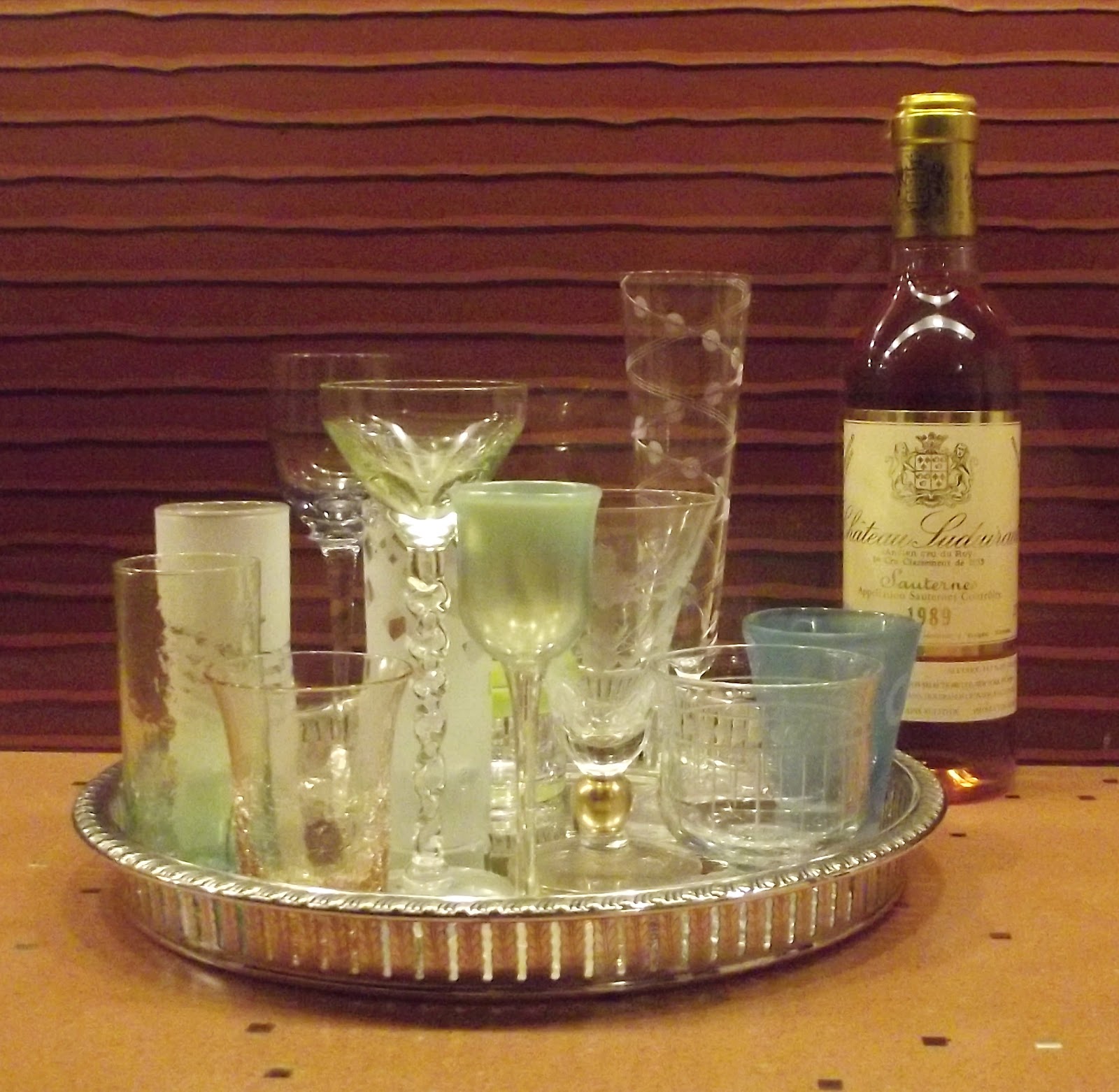
For years, though, I had no decent dessert wine glasses. Which didn’t stop me from serving dessert wines, it just wasn’t as celebratory as I wished. But one day, I was wandering through an antiques fair in Maine, and I came across a table of assorted glassware – one of these, two of those, etc. And I decided to start a collection of single dessert wine glasses. I found some, like these, at estate sales. The one on the far right is pink depression glass.


 Some I bought at art fairs from glassblowers.


And this one, my favorite, I bought at auction. It’s a Louis Tiffany original.


You don’t have to spend a lot, though, and occasionally, I’ll trade out one that I’ve stopped loving in lieu of one that seems a bit more special or fun. A decorator friend of mine once told me that a collection shouldn’t have more than 12 items. “Once you get 12,” she said, “you should start on a new collection.” So while I now have a couple more than 12 – but only a couple – I enjoy the changing nature of the group.

They look like a party, clustered there on the tray, and I think my guests get a kick out of choosing their glass.

Wednesday, July 18, 2012

Visions of Sugar Plums... in July?


It must be a sickness with me. I’m leaving today and will be away for 10 days, so I shouldn’t really have even gone to the farmers’ market on Sunday. But I’m so weak.

I swore to myself that I would ONLY get some zucchini and peaches. I’d have time to make my friend Laurie’s wonderful zucchini soup and freeze it, and if I didn’t have time to do something with the peaches, well then, I’d just take them on the trip with me. Sometimes I get on the plane with the most random assortment of food items – stuff I think I’ll eat for lunch in the air, or things I know won’t hold in the fridge till I get back, or even food I want to share with friends at my destination. My grandmother always used to pack a PB&J and a banana when she was taking a flight, thereby embarrassing my mother and aunt practically to tears. “Mother,” they’d say, “you’re not from the back woods. They’ll feed you on the plane.” Of course, these days, what you can get on the airplane is pretty pathetic, so I generally feel justified, even if I look like Minnie Pearl in the process.

But when I got to the farmers’ market, the first booth I stopped at had this beautiful display of sugar plums. I’d never made anything with sugar plums, but when I asked the woman at the cash register what to do, she told me they’d had a couple of chefs show up for these beauties because they wanted to make soup. And that was all it took.

So I made a Cold Sugar Plum Soup with part of my bounty, and because in my enthusiasm I overbought on the fruit, I made Sugar Plum-Cantaloupe Sorbet with the rest. I will warn anyone who wants to try these recipes that it’s a wee bit messy and tedious getting the seeds out of the little sugar plums, but if you have a nice TV show that you don’t have to give too much attention, it’s almost painless. I replayed the latest episode of HBO’s Newsroom, which btw, my husband and I are thoroughly enjoying, and I was done in no time. Just don’t buy the full three and a half pounds of sugar plums at one fell swoop like I did.

To put together these recipes, I just looked at a bunch of plum-based dishes and started playing around with the flavors I liked best. They’re really simple, and extremely flexible, so if you want to try a basil-based simple syrup or maybe a tarragon-based simple syrup, I encourage you to jump right in. I added cantaloupe to the sorbet to give it more body and to tone down the tartness of the plums, but you could use peaches or honeydew melon to equal effect. (And if you do, please let me know how it turns out. I can't seed any more plums this week.)

Kitchen Goddess note: It will not hurt you to have some Minted Simple Syrup – or even Simple Simple Syrup – in a jar in your fridge. It keeps for ages, and is great for sweetening iced tea or mojitos, or even another sorbet or soup.

If you can’t find sugar plums, hang onto these recipes for another month and use them with full-sized plums.

Cold Sugar Plum Soup
(Makes 4 cups)


For the Minted Simple Syrup (from Gourmet, August 1998):
1½ cups packed fresh mint leaves
1 cup water
1 cup sugar
For the Simple Simple Syrup:
1½ cups water
¾ cup sugar
1½ pounds sugar plums (or any other kind of plum), seeded
juice of ½ lime

For the Minted Simple Syrup, chop the mint and stir it together with the sugar and water in a saucepan. Bring the mixture to a boil, stirring only until the sugar dissolves. Simmer without stirring for 2 minutes. Pour the mixture through a fine sieve into a bowl, pressing on the mint to extract all the syrup. Throw away the mint and store the syrup in a jar or other covered container in the refrigerator. You will have about 1½ cups of syrup.

For the Simple Simple Syrup, in a clean saucepan, stir together the remaining water and sugar. Bring the mixture to a boil, stirring only until the sugar dissolves. Remove it from the heat and store.

In the meantime, place the sugar plum flesh and skins in a blender. Add ¾ cup of Simple Simple Syrup and ¼ cup of Minted Simple Syrup and puree well (3-4 minutes). Strain using a fine-mesh strainer and stir in juice of ½ lime.

Chill and serve cold.


Sugar Plum-Cantaloupe Sorbet
(Makes about 8 cups)

2 pounds sugar plums, seeded
2 cups water
1 cup sugar
flesh from ¼ of a ripe cantaloupe, rind and all traces of green removed
2 teaspoons Cointreau (or other citrus-based liqueur)

Put the flesh from the plums into a nonreactive (not copper or aluminum) saucepan. Add the water, cover, and bring to a simmer. Simmer 8 minutes, covered, stirring occasionally. Remove from heat and add the sugar, stirring until the sugar dissolves. Cool to room temperature.

Cut the cantaloupe into chunks and process in a blender until relatively smooth (20 seconds). Add the cooled sugar plum mixture to the blender and puree thoroughly (3-4 minutes), until very smooth. Pour the purée through a strainer to remove the bits of skin, and stir in the Cointreau.

Chill the mixture for several hours, then freeze it in your ice cream maker according to the manufacturer’s instructions.

Saturday, July 14, 2012

Almost Weekly Foodie Faves: A Friday Bloguette


Color plate from Köhler's Medicinal Plants

Today’s bloguette is not only a day late, the topic is nothing new. Literally. Writing about ginger has been a foodie practice almost as old as the use of ginger itself. According to the web site for the Royal Botanic Gardens, Kew (a.k.a. Kew Gardens), the Hindu epic Mahabharata, written around the 4th century BC, describes a meal where meat is stewed with ginger and other spices. Who knew that ancient Hindu Vyasa was a foodie?

I like ginger in almost any form – powdered in ginger snaps, pickled with sushi, grated in Roasted Sesame Green Beans, candied in Sweet Potato Ginger Soufflé,... I have an enduring memory of my mother bringing me ginger ale on ice any time I had the flu as a child. She knew ginger is a tasty way to settle a queasy stomach.

Raw ginger rhizomes, which is a staple in my freezer.

But among these various forms, my favorite is candied ginger. It has the best combination of taste and portability, which is why it’s also the form most often recommended to fight nausea – with chemotherapy patients, with morning sickness in pregnancy, with seasickness, or with post-op nausea. It’s even good as a fat-free snack, though it’s definitely not low-cal.

Candied ginger from Penzeys Spices

In addition to snacking on the stuff, I use it as often as I can with other foods:

■ I sprinkle it on the whipped cream I serve atop my Aunt Marcy’s Pumpkin Chiffon Pie.

■ I mix it with sections of Texas Red Grapefruit (the official state fruit of Texas) for a dessert.

■ I add it with a teaspoon of honey to plain yogurt for breakfast.

■ I substitute it for the raisins in my mother-in-law’s recipe for Scones.

And I welcome any other suggestions!

Tuesday, July 10, 2012

A Time for Frozen Fruit


What is happening here? We left Austin for Jersey City in order to escape the summer heat, and for the last several days, the weather forecast has actually been worse in NJ. Where is the justice??!! I can’t even imagine what it has been like for all those poor souls who’ve endured this wave without A/C.

When I was in my teens, and central air was something you only got if you had a brand-new house, my parents splurged and installed window air conditioners in the upstairs of our house. And I would actually close off my room and open the windows because I didn’t like the smell of the cool air. Deep in the heart of Texas. Thinking about it now, I can only imagine it was a combination of teenage hormones and just outright lunacy. In general, I’ve recovered from that phase of my life, although there are days in Austin when my husband will return from the golf course and find me in the house with all the doors and windows open and all the fans going... at 84-85°. He would tell you I’m still a bit nuts, and maybe he’s right.

In any case, even I have limits. So aside from trips to the farmers’ market, I’ve been staying inside, spending my time thinking about ice cream and sorbet.


The farmers’ market has been exploding with fruit, and frozen desserts are a great way to use them. In the non-frozen category, I cooked up a sweet-tart rhubarb compote a couple of weeks ago – nothing more to it than simmering the sliced rhubarb with sugar for 10 minutes and adding a bit of lemon juice. It’s great on vanilla ice cream, with roast pork tenderloin, and in cottage cheese for breakfast. And I made a tingly spiced strawberry sorbet with the last of the local strawberries. Oh, my.


The season now is for peaches and blueberries, so we had a creamy, slightly chunky peach ice cream last night for dessert. But it was a bit rich for this weather, so for tonight, I adapted the spiced strawberry sorbet recipe to blueberries. These frozen treats are unbelievably simple if you just have an ice cream maker – and if you don’t, what’s holding you back?


 My Texas machine is a Donvier hand-crank, and in NJ I have a Cuisinart electric model that my son and daughter-in-law gave me for Christmas, along with this really excellent book on frozen desserts (where I found the peach ice cream recipe) by David Lebovitz. Both machines work well, though I’ll confess that the electric one takes hardly any effort at all. Here’s the recipe for spiced blueberry sorbet. Steeping the simple syrup in cracked peppercorns adds a tiny bit of bite that gives your mouth that “Oh, wow” feeling.


A Kitchen Goddess note about crushing peppercorns: You could use a grinder if you had one with a very coarse setting, but I find it’s just as easy to pour the peppercorns into a plastic zip-top bag or even a paper envelope. Seal the bag or envelope and lay it on your countertop. Give it a few good whacks with something flat – like the bottom of a glass measuring cup or a meat mallet or the broad side of a hammer. It’s not necessary to get them all cracked, just mostly cracked.


Spiced Blueberry Sorbet, adapted from Gourmet, August 1995


Yield:  about 1 quart

⅔ cup sugar
⅔ cup water
3 tablespoons black peppercorns, crushed coarsely
1 quart blueberries (preferably local)
2 tablespoons balsamic vinegar, or to taste

In a saucepan, combine the sugar and water and bring it to a boil, stirring until the sugar dissolves. Stir in the peppercorns and remove the pan from the heat. Cover the pan and let the syrup stand 1 hour.

Strain the syrup through a fine sieve into a food processor or blender and discard peppercorns. Add the blueberries and purée with the syrup until very smooth (4-5 minutes). Stir in vinegar and chill, covered, until cold. Freeze mixture in an ice-cream maker.


Friday, July 6, 2012

Almost Weekly Foodie Faves: A Friday Bloguette


I’m such a geek. I love kitchen/food trivia, especially if it’s helpful. So it was a big day for me when I read about a woman named Shirley Corriher, in the Vanderbilt Alumni Magazine. Yes, we attended the same school, so I feel a special closeness to this woman, even though I’m pretty sure she went to more classes than I did.


Corriher got a B.A. (cum laude) in chemistry from Vandy, then worked as a biochemist in the medical school while her husband went to graduate school. They moved to Atlanta where they started a boys’ school, and Shirley had to learn to do the cooking. From the interview I read, it sounds like she knew almost as little about cooking as I did when I graduated. She eventually divorced, and while scratching around to support herself and her three sons, she won cooking classes at an Atlanta cooking school. But with her chemistry background and strong communication skills (thanks to Vandy’s excellent English department), she soon became the go-to for any oddball food science questions at the school. Perhaps the lesson here is that you may not learn how to cook at Vanderbilt, but you will learn how to ask someone to teach you.

In any case, today, Shirley Corriher is an internationally known food scientist, teacher, and cookbook writer; her book, Cookwise: The Secrets of Cooking Revealed, is a bestseller and won a James Beard Award for excellence.

So here, for your Friday Fave, is a handful (that would be five) of tidbits from Cookwise:

1. The biggest factor in whipping cream is temperature. So in addition to freezing the bowl and beaters ahead of time (which the Kitchen Goddess has always done), don’t try to whip cream in a hot kitchen. To get whipped cream that holds up in hot weather, try adding a near-melted marshmallow at the end of whipping (one large marshmallow, cut into quarters and microwaved until it’s very soft, per cup of cream). The gelatin in the marshmallow will help keep the whipped cream firm. (p. 455)

2. Not all baking pans work the same. Cakes in dark pans bake faster but create a dark crust; cakes in glass pans bake even faster. Dull pans absorb more heat than shiny aluminum pans. Professional cake bakers prefer heavy, dull aluminum, straight-sided pans. (p. 151)

3. The best way to store lettuce and other tender salad greens is to first soak them in ice water for 10-30 minutes, then (for one-day storage) wrap them in a wet cloth or paper towel, put in a zip-top bag and squeeze out the air before refrigerating. For storing more than one day, use a salad spinner to remove as much surface moisture as possible, then wrap them in a dry paper towel in a zip-top bag and, again, squeeze out the air before refrigerating. Squeezing out the air deprives the leaves of oxygen; they’ll keep several weeks that way. (p. 313)

4. Bread keeps best frozen or at room temperature – not in the refrigerator. The starch in bread changes to a hard, crystalline form at refrigerator temperatures. (p. 93)

5. Making deviled eggs? Start with older eggs (7-10 days), which are easier to peel. To get yolks that are more consistently centered, store the carton – tightly closed – on its side overnight before you cook them. Next best is to store them large end down. (p. 198)

Isn’t this fun?

Tuesday, July 3, 2012

Red, White, and Blueberry Syrup


Last year at this time, I was bemoaning our inability to see the NYC fireworks celebration because the city had moved it so far north as to be out of our field of vision. Well, it’s still out of sight, but this year, I have something much more spectacular to watch. My son and daughter-in-law are invited to a party not far from us, so Grumpy and I have been asked to babysit for our 6-month-old granddaughter.

She’s not yet on solid foods, aside from her morning oatmeal, so I can’t cook anything for her. And she goes to bed waaaay before I do, so she’s not much for evening companionship. But she doesn’t seem to mind if I just sit and stare at her, which I confess that I do a lot. So it’ll be a quiet celebration of July 4th, but somehow, I don’t mind at all.

Our quiet celebration will nevertheless include dessert. I’ve been buying blueberries by the armful at the farmers’ market, and one thing I’ve been making with them is the Blueberry Syrup I wrote about in my July 4th post last year. Has anyone made it? OMG – it’s just delicious, and beautiful, and very easy if a little time-consuming in the part where you strain out the skins. 

For a Fourth of July celebration, I’ve realized that there are any number of red-white-and-blue ways to serve it that all look delicious and are incredibly easy.

You can surround a scoop of vanilla ice cream with straw-berries and drizzle the syrup on top.


Or you can make a strawberry/vanilla ice cream/blueberry syrup parfait.


Another twist I came up with was to let the ice cream melt a bit and stir the syrup into it along with a handful of blueberries. You could do the same with good plain yogurt instead of ice cream.


Finally, you can serve a mix of blueberries and strawberries, top them with a dollop of either whipped cream or (as here) a dollop of crème fraîche, then drizzle on some blueberry syrup.


But whatever you do, Grumpy and my granddaughter and I wish you a safe and happy Fourth of July!