Showing posts with label sheet-pan dinners. Show all posts

Wednesday, November 30, 2022

Enough with the Leftovers!

What’s cooking? Sheet Pan Shrimp Scampi


So are you tired of Turkey Day leftovers yet? I’ve now had stuffing for lunch three days in a row, and turkey soup for the past two dinners. Thanksgiving is the gift that keeps on giving, even when you want it to stop.

How about something light? Anyone for shrimp? Fresh, wild-caught shrimp are a delicacy I don’t often get in the summer, mostly because we spend that time in New Jersey, where scallops are the fresher, more plentiful alternative. Not that you can’t get good, fresh-frozen shrimp at the better grocery stores there, but if you want truly fresh, wild-caught shrimp, your best bet is to be near the Gulf or the southern Atlantic coast.

As it happens, the Kitchen Goddess has a private source for shrimp. My brother, who lives in the tiny coastal town of Port Aransas, Texas, periodically heads down to the wharves when the shrimpers are coming in and bags a few pounds that he then ships overnight to me. I know, I know – I don’t deserve such largess. So I send him the occasional tin of my rollout cookies, and he seems to think it’s an acceptable trade: cookies for shrimp.

According to The New York Times, some large chains, like Wegman’s and some regional Whole Foods Markets, as well as upscale markets like Eataly and the Lobster Place in New York, also carry fresh shrimp, albeit at a premium price. But most wild shrimp is frozen and shipped around the country, where it shows up either in bags in supermarket freezers, or thawed and piled on ice. The quality varies widely, depending on how the shrimp was processed after catching. The best quality wild shrimp have been frozen without chemicals, either onshore soon after harvesting, or on plate freezers while still on the boat. You can find this shrimp at upscale supermarkets and fish shops; ask for chemical-free wild shrimp.

Good shrimp have such wonderful flavor that the simplest preparations are the best. The one here is so simple it seems like hardly any trouble at all. And the Kitchen Goddess loves any recipe that lets her avoid stove-top cooking in favor of a sheet pan.

The garlicky, lemony flavors are the same as in classic shrimp scampi, but cooking the whole thing on a sheet pan is even simpler than in a skillet, and roasting the lemon slices adds caramelization and a deep, concentrated lemon flavor that you don’t get as strongly with the skillet method. Surrounding the lemon slices with the wine produces a sauce you don’t even have to think about. And then there’s the butter... 

Need I say more? Serve it with crusty bread for dipping, or over pasta or rice to absorb the sauce. A bonus spritz of lemon juice and red pepper flakes or Aleppo pepper add a final flourish. And the whole process takes less than half an hour, so get that parsley chopped before you start. Your family and your guests will love you for the change of pace.
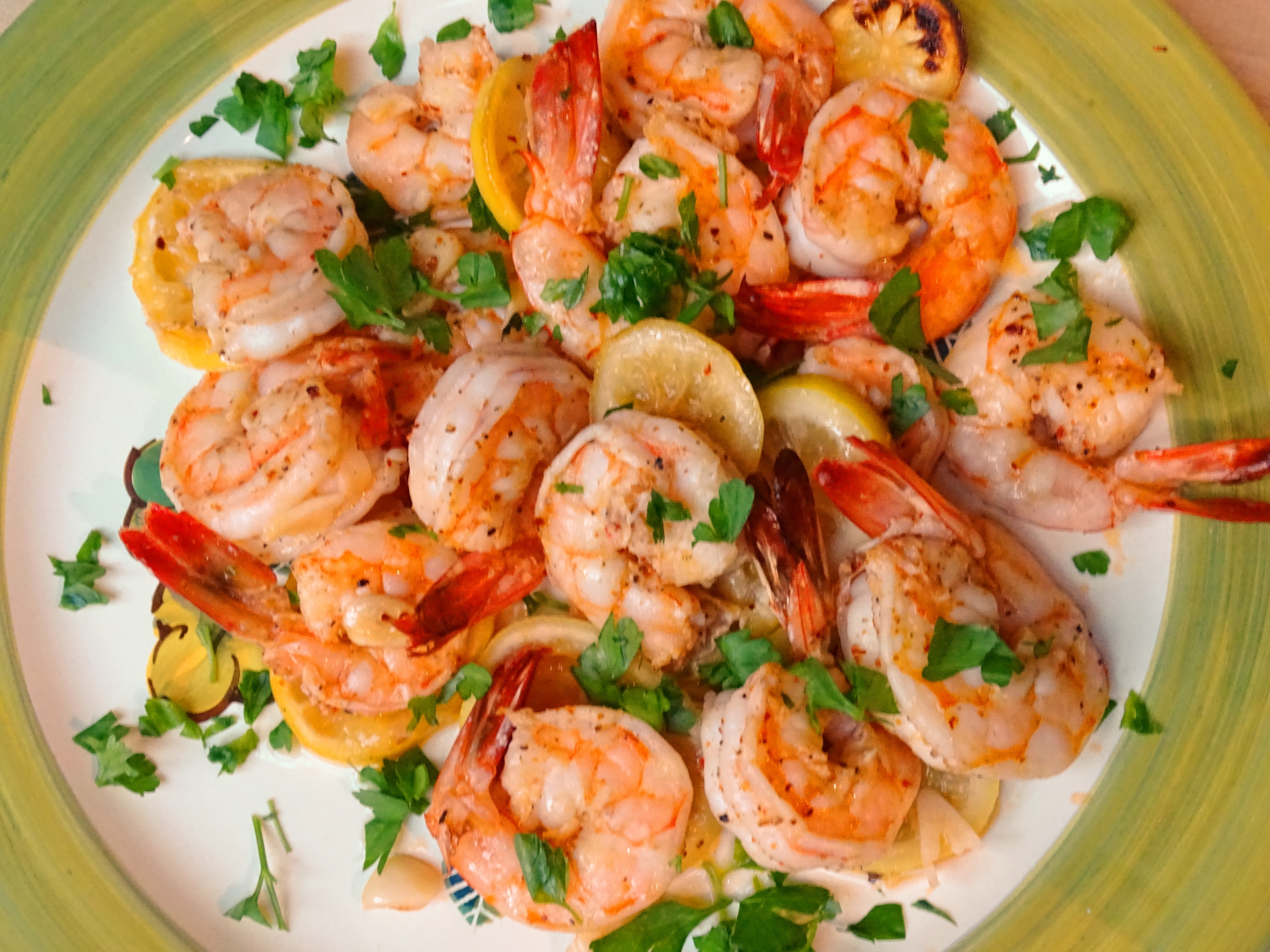


Sheet Pan Shrimp Scampi

Adapted from Melissa Clark in The New York Times.


Serves 2-3.


Ingredients

2 lemons (one for cooking, one for serving)
Extra-virgin olive oil
1 teaspoon fine sea salt, plus more as needed
1 cup dry white wine
3 tablespoons unsalted butter
1 pound peeled large or extra-large shrimp
2-3 garlic cloves, thinly sliced
¼ teaspoon Aleppo pepper or ⅛ teaspoon red pepper flakes
Freshly ground black pepper
¼-½ cup fresh parsley, chopped


Directions

Note: In some stoves, the broiler is separate from the oven; in others, the difference between broiling and baking/roasting is merely a setting. These directions attempt to accommodate that difference.

Preheat your oven to broil, with a rack set about 4 inches from the heating element. If your oven is separate from your broiler, also heat the oven to 450º.

Slice one of the lemons into ¼-inch thick slices. Remove the seeds. Arrange the lemon slices in a single layer on a rimmed baking sheet.


Brush the lemon slices generously with oil and sprinkle lightly with salt. Carefully pour the wine onto the baking sheet, without pouring it directly onto the lemon slices.

Broil the lemons and wine until the tops of the lemon slices are caramelized and charred in spots, and the wine has reduced by half. This can take anywhere from 6 to 12 minutes, depending on the intensity of your broiler, so watch carefully.

Once the lemons are caramelized and the wine is reduced, remove the pan from the heat. (If your broiler is in your oven, switch the setting from broiler to baking/roasting at 450º.)

Meanwhile, in a medium pot over medium heat, melt the butter. Off the heat, combine the raw shrimp, garlic, ¾ teaspoon salt, the Aleppo pepper (or red-pepper flakes) and black pepper, then toss with the butter to coat the shrimp well.


Transfer the shrimp mixture to the baking sheet, arranging the shrimp in an even layer on top of the lemon slices. Roast at 450º for 3-5 minutes, until the shrimp are cooked through. Remove the pan from the oven and toss the lemons and shrimp together; taste, and add more salt if needed. 

Move the shrimp, lemons and any pan juices to a serving platter and sprinkle with parsley and more Aleppo pepper (or red-pepper flakes).


Serve immediately, with thick, crusty bread or pasta or rice to soak up the juices. Serve wedges from the reserved lemon for squeezing.


Thursday, October 27, 2022

Throwback Thursday

What’s cooking? Sheet-Pan Skirt Steak with Broccoli and White Beans


It occurred to me the other day – as I was thinking about dinner – that I have been writing this blog for 13 years. Yes, just the 13 years. That’s a lot of recipes... almost 400, if you’re counting. But who’s counting?

In any case, while not every recipe has been a winner, many of them are really excellent, if I do say so myself. Quite a few that even the Kitchen Goddess has forgotten about. So I’m going to toss a few of those your way, on a somewhat regular basis, and hope that you will re-discover a winner. And if you haven’t been paying super-great attention for all this time, you might discover one for the first time.

Today’s “throwback” dish was posted Friday, December 9, 2016. I made it just the other night for my prince, and we were both struck at how tasty – and easy – it was. Then I mentioned the dish to a neighbor, and she liked the sound of it so much that she made it, too. And loved it. And her family loved it. So that was enough encouragement for me. And we both like that it was a single sheet-pan dinner.

Back when I posted this recipe, I had seriously overbought in the balsamic vinegar section of my grocery store. So I needed a way to use it. And the fact that this recipe uses a half cup of the stuff weighed heavily in its favor. That combination of sweet from the balsamic vinegar and pungent tang from the mustard act like magic with the flavor of the meat. Here’s what else I noted in the post:

■ The whole meal cooks in one pan. Get that? The whole meal. One pan. (Okay, you’ll also want a big bowl for tossing the broccoli and a small bowl or jar for the dressing/marinade, but let’s not quibble over numbers.)

■ The process – which included trimming and slicing the broccoli – took less than an hour. (Kitchen Goddess aside: The sweetness of those big, thick broccoli stems, when trimmed of the tough outer layer, will surprise you.)

■ The deliciousness factor is way high because the meat juices drip down to flavor the beans and broccoli as they cook. For maximum flavor, do yourself a favor – a flavor favor! – and get fresh oregano.

■ The concept is terrifically flexible: the meat can be hanger steak or skirt steak or flank steak, the veggies can be broccoli or broccolini or (according to reviews) brussels sprouts or asparagus. And the beans can be any canned white beans: Great Northern, navy, cannellini. (Just FYI, the Kitchen Goddess’s faves are the large white cannellini, but she has used navy beans and even black-eyed peas in a pinch. Don’t make another trip to the store just for the beans.)

The nitpickers  more astute observers among you will note that the headline says “skirt steak,” and yet the photos are all of hanger steak. You work with what you’ve got – or, rather, what your butcher has to offer. I make this point to prove that it doesn't really make any difference which of these cuts you find. Most recently, we had skirt steak, and loved every bite.  

Kitchen Goddess note on meat: The three beef cuts that are best for this type of cooking – skirt steak, hanger steak, and flank steak – are all what used to be known as “butcher’s steaks,” because butchers would often keep it for themselves rather than offer it for sale. Hanger and skirt steak come from the diaphragm, while flank steak comes from an area behind the diaphragm. They’re not pretty, and they’re not sliced from a larger part of the cow, so they are the shape and size they are. But they’re very flavorful. They need to be marinated, to tenderize them, then cooked quickly and at high heat. Before serving, you should slice them thinly and against the grain of the beef.

Skirt steak and hanger steak come from the diaphragm. Both are prized for their flavor, but both need marinating for a good hour. If you get skirt steak, ask your butcher to remove any traces of the tough membrane that surrounds it. Flank steak is leaner and not quite as flavorful, but responds well to marinating. Flank steak and skirt steak are popular as fajita meat; hanger steak is mostly used in French restaurants for steak frites. All three – hanger, skirt, and flank meat – should be cooked quickly and at high heat. 


Sheet-Pan Skirt Steak with Broccolini and White Beans

Adapted from Rhoda Boone in epicurious.com, August 2015


Serves 4.


Ingredients
4 large garlic cloves, divided
½ cup balsamic vinegar
3 tablespoons Dijon mustard
2 tablespoons chopped fresh oregano leaves, divided
1½ teaspoons kosher salt, divided
¾ teaspoon freshly ground black pepper, divided
½ cup plus 2 tablespoons extra-virgin olive oil, divided
1½ pounds skirt steak (or hanger steak or flank steak – see note above.If you use skirt steak, which is long and thin, cut it into two short pieces, for more even access to the heat)
1 pound broccoli or broccolini
1 can (15-ounce) white beans, drained and rinsed

Special equipment: An ovenproof wire rack that fits inside an 18x13-inch rimmed baking sheet


Directions
Make the vinaigrette marinade: Mince 2 of the garlic cloves and put them into a large jar or medium bowl. Add the vinegar, mustard, 1 tablespoon of the oregano, 1 teaspoon of the salt, and ½ teaspoon of the pepper, whisking to combine well. Slowly drizzle in ½ cup of the oil, whisking constantly to emulsify the mixture. Set aside ¼ cup of the vinaigrette for serving.

Place the steak into a half-gallon zip-lock bag and pour in the remaining vinaigrette. Seal the bag and massage to coat the meat with the vinaigrette. (Alternatively, you can place the meat in a shallow glass dish and pour the marinade over it. But that would mean dirtying another dish, wouldn’t it?) Let the meat marinate at least 30 minutes or up to 1 hour.


While the meat is marinating, use a vegetable peeler to remove the tough outer layer of the broccoli stems, and slice the broccoli lengthwise in pieces about ¼ inch thick. (If you have broccolini instead, slice only the thickest of the stems.)

Preheat the broiler and thinly slice the remaining 2 garlic cloves.


In a large bowl, toss the broccolini with the remaining 2 tablespoons of oil, 1 tablespoon of oregano, ½ teaspoon of salt, and ¼ teaspoon of pepper. Lay the broccoli out on a rimmed baking sheet, and broil it about 4 inches from the heat for 5 minutes, then remove the pan from the oven. Spoon the beans around the broccoli and scatter the sliced garlic on top. Set the wire rack on top of the beans and broccoli. Remove the steak from the marinade and allow excess to drip off. Place the steak on the rack and discard the marinade.

Broil the steak about 3 minutes per side for medium-rare. (If you use hanger steak, which is thicker, let it cook an extra minute per side.) Remove the pan from the oven and let the steak rest 5 minutes before slicing.

Hanger steak, which is thicker than skirt steak.

Meanwhile, divide the broccoli-bean mixture among four plates. Thinly slice the steak against the grain (i.e., perpendicular to the long thin strips of muscle) and serve with the reserved vinaigrette alongside.

If you are more organized than the Kitchen Goddess, you can make the vinaigrette up to 3 days ahead.

And a Happy Halloween to you all!


Saturday, February 2, 2019

I’m Rooting for the Blue and Gold Team

 What’s cooking? Sheet-Pan Salmon with Miso and Maple Syrup


When my two sons were living at home, Sunday afternoons were often devoted to watching
football. As a native Texan, I usually rooted for the Cowboys if they were playing – a practice that inevitably was a source of derision from the men in my family, who were all die-hard Steelers fans. If neither of our teams were playing, I almost always favored the team with the better looking uniforms – another reason for hooting from the male gallery.

The fact is that I don’t really like football, which I think I’ve mentioned to you before. That doesn’t stop me from going to the football-watching parties. Especially the Super Bowl parties, to which I invariably take my famous roll-out cookies. I make only stars, and decorate them in the colors of the teams who are playing. I love the challenge: How many different designs can I deliver given only 2-4 colors?

Patriots... again. These were for 2018, against...

But I’m getting a little weary of the Patriots’ success. I’ve iced and sprinkled my way through way too many red/navy/silver color schemes.

... the Eagles.
And before that, against the Falcons in 2017.
While I enjoyed decorating for the Eagles (midnight green/silver/black/charcoal) last year, my favorite year so far was 2014, when the Broncos (navy/orange) played the Seahawks (navy/gray/neon green). I don't have photos of 2014, but those were some fun colors – especially that neon green. And I long for the Dolphins (aqua/blue/orange) or maybe the Jaguars (black/teal/two shades of gold) to show up in the Super Bowl. Gimme some help, fellas!

I like the Broncos' colors. These were from 2016, against...
... the Panthers.

In the meantime, this year, I have to be content with the Rams’ decision to wear bright blue and yellow – a tribute to their win against the Titans in 2000, and a little more fun than their traditional navy, gold and white. And I’ll dream about a day in the far future when we have a Super Bowl whose participants are chosen on the basis of their uniform colors.

* * *

Even though it’s been a while since I’ve written, I haven’t stopped cooking. No sirree. And today I have a real treat for you. I’d call it a sheet pan dinner, but it really needs rice. Because you don’t want to leave any of that unbelievable marinade in the pan – you will want it on the plate and in your mouth. Let me just say that the leftovers engendered a small lunchtime skirmish the next day between me and my prince.

You’ll notice I also didn’t call this Salmon with Asparagus. That’s because it really makes almost no difference whether you use asparagus or green beans (which is what the author of this recipe used in The New York Times) or broccolini or broccoli. The Kitchen Goddess had asparagus, so by god that's what she cooked. The secret to this dish is the miso.

It comes in a big container, but it keeps 1-2 years in the fridge.
 Toss if moss/mold develop.
Kitchen Goddess note: Miso is a paste made mostly from fermenting soybeans. It’s a traditional Japanese seasoning with lots of uses, from sauces to pickling to soup base. High in protein, rich in vitamins and minerals, and gluten-free for those of you who care, miso is a culinary staple in both traditional and modern Japanese cooking, and these days, it’s become a star in the culinary firmament.

The most common flavor categories are white, red, and “mixed,” with the white miso being somewhat mellower or milder in flavor than the red. But all have an amazing impact on a dish, increasing the complexity of the flavors. Through the fermentation process, miso is a chief source of umami, one of the five basic tastes in addition to sweet, salty, bitter, and sour.

Try this: Take a couple of teaspoons of miso paste in a mug, dissolve it into a slurry with a tiny bit of warm water, add a cup of not-quite-boiling water and a nice squeeze of lime, and you have a terrific broth to drink as a pick-me-up between meals or a light addition to your lunch. The taste is mysterious – sweet, salty, nutty, mellow – and all from some fermented soybeans.


Sheet-Pan Salmon with Miso and Maple Syrup

Adapted from Colu Henry in The New York Times.

In the classic coffee-cream-sugar combination, the fat (cream) evens out the bitterness of the coffee and the sweetness of the sugar to produce a flavor combination that’s popular around the world. Similarly, in this recipe, the fattiness of the salmon evens out the flavors between the various components of the marinade: the rice wine vinegar (bitter), the maple syrup (sweet), and the soy sauce (salty). But the kicker is the miso, which adds a big dose of umami.

As I said, you need rice, though I expect egg noodles would also work. Once you start the rice, the rest of the dinner can be ready by the time the rice is done. It’s that fast.

Serves 4.

Ingredients
4  (6-ounce) skin-on salmon fillets, about 1-inch thick
Kosher salt
Freshly ground black pepper
2 tablespoons plus 2 teaspoons maple syrup
2 tablespoons white miso
2 tablespoons rice wine vinegar (a.k.a. rice vinegar)
4 teaspoons soy sauce
2 garlic cloves, finely grated (use a rasp grater)
1½ pounds asparagus (or a pound of green beans), trimmed
4 tablespoons olive oil
½ teaspoon Aleppo pepper (or a pinch of red-pepper flakes)
½ teaspoon toasted sesame oil

Garnish: ¼ cup roughly chopped cilantro, using both leaves and tender stems
4 lime wedges, for serving

Cooked white rice, for serving

Directions
Line one or two sheet pans with baker’s parchment or aluminum foil. Rinse the salmon and pat dry with paper towels. Season well with kosher salt and freshly ground black pepper. Place the fish in a bowl or glass baking dish.

In a small bowl, combine the maple syrup, miso, rice wine vinegar, soy sauce, and garlic. Mix well, and pour over the salmon. With your fingertips, gently massage the marinade all over the fish. Let the fish marinate while the oven comes to temperature.

Preheat your oven to 400º.

In a large bowl, toss the asparagus (or whatever green veggie you chose) with the olive oil, Aleppo pepper, and sesame oil. Season to taste with kosher salt and freshly ground black pepper.

When the oven has reached 400º, lay the salmon fillets skin-side down on the prepared sheet pans and scatter the asparagus (or other veggies) between and around the fillets. Spoon the remaining marinade over the fish.

Baked salmon and asparagus, before the final burst from the broiler. These fillets were 3 ounces each.

Bake the salmon and veggies for 12-15 minutes, depending on the thickness of the fillets. When the salmon is nearly done, raise the oven temperature to broil and leave the pans another 1-2 minutes to lightly caramelize the glaze on the fish.

And after two minutes under the broiler.

Serve with white rice, lime wedges, and a scattering of cilantro.