Showing posts with label peaches. Show all posts

Tuesday, September 7, 2021

Peachy Keen – part 2

 What’s cooking? Herby Grilled Chicken Thighs with Pickled Peaches


Kitchen Goddess note: I have discovered – via epicurious.com – that if you can’t find fresh peaches, the pickling recipe below will also work – equally well – with canned peach halves. I haven’t tried it that way, but epicurious.com hasn’t lied to me yet... And I’ll probably try it at some point just out of curiosity, as the pickling juice is a terrific addition to my collection of Useful Liquids to Have in the Fridge.

With every year that I spend back in my home state of Texas, I’m reminded of some of the culinary traditions that were part of my childhood. For instance, Southern cooks will fry almost anything, and if they can’t fry it, they just might pickle it instead. Some foods, like okra, might be treated either way. My mother pickled eggs and beets and jalapeños – often all together. And with peach season on the wane, pickling is a way to preserve them without making jam.

At my grandmother’s house, many meals included a pickled peach half, often on a piece of iceberg lettuce or served in a cut glass bowl on the Sunday table. I loved those peaches, of which my grandmother seemed to have an endless supply. So when I moved back to Texas as an adult, I felt sure I’d find them again. I’ve looked long and hard in every southern grocery store, to no avail. And then I found this recipe. The brine is a bit tarter than I remembered, but the tangy kick of the vinegar with that bouquet of warm spices (clove, cinnamon, ginger, allspice) takes me right back to my grandmother’s table.

Today’s recipes were part of a feature on peaches in the August 2016 issue of Food & Wine magazine – an issue I discovered here in our NJ condo when we returned this summer after our COVID hiatus. Clearly, that issue had been waiting for me. The recipe appeared courtesy of Southern super-chef Sean Brock, who at the time was serving the pickled peaches grilled (!) with chicken thighs. I’ve tried it, and it’s outstanding. And now, I bring it to you.

Many of you will shy away from the idea of pickling peaches. I get that. But trust the Kitchen Goddess and give this a try. (Or, if you’re sufficiently intrigued to try eating them but not cooking them, you can apparently order them online from Walmart. Who knew?) Eat them by themselves, or:

■ with vanilla ice cream on top, or chopped and on top of the ice cream;

■ piled in wedges on toast spread with burrata;

■ alongside grilled meats, like pork chops or chicken;

■ alongside burgers or sandwiches, instead of a pickle;

■ to elevate a cheese plate, as recommended in Southern Living magazine.

■ Or served as my grandmother did – in a cut glass bowl, of course – as a condiment with roast chicken or turkey for Sunday dinner.

Southern Living also suggests that you save any leftover brine and add a splash to vinaigrettes or iced tea. That salad dressing idea is part of today’s recipe. Great minds...


Pickled Peaches

Adapted from Chef Sean Brock, founder of Husk Nashville, in Food & Wine Magazine


Ingredients
5-6 firm-ripe medium-sized peaches
1½ cups distilled white vinegar
1 cup sugar
1 stalk lemongrass, tender inner bulb only, thinly sliced
One 1-inch piece fresh ginger, peeled and thinly sliced
½ teaspoon whole black peppercorns
5 allspice berries
2 whole cloves
One 3-inch cinnamon stick

Special equipment: 2 quart-size jars with lids, or 1 half-gallon jar with lid

Directions

Kitchen Goddess note on peeling peaches: I find that ripe peaches are easy to peel; if you do not, or your peaches are just being difficult, use a sharp paring knife to cut a small X into the bottoms of the peaches and drop them into a saucepan of boiling water for 1-2 minutes. Remove them from the water into an ice bath to cool; the skins should come off easily. Discard the water and wipe out the saucepan.

Slice the peeled peaches in half and remove the pits. Reserve the peach halves in a heatproof bowl.

Use the saucepan to combine the rest of the ingredients plus 1½ cups of water. Stir until the sugar dissolves. Bring the mixture to a boil, and pour it over the peach halves. Let the bowl cool to room temperature, then cover with cellophane wrap and refrigerate overnight.

If you will not be using the peaches the next day, store them in jars with as much brine as will fit; save the remaining brine in a separate container, and use it in pickling other fruits or veggies... or more peaches!


* * *


Even if you decline to try pickling peaches, this chicken recipe is one you’ll surely want to keep. The Kitchen Goddess has executed this dish on a grill and under a broiler, and both ways are good.


Herby Grilled Chicken Thighs with Pickled Peaches

Adapted from Chef Sean Brock, founder of Husk Nashville, in Food & Wine Magazine


Serves 4. (To serve 2, don’t bother cutting the molasses/salt/water mixture in half, but do halve the rest of the ingredients.)


Ingredients
1 tablespoon sorghum syrup or molasses
2 tablespoons kosher salt, plus extra for seasoning the arugula
8 skin-on, bone-in chicken thighs (2-2½ pounds)
½ cup plus 1 tablespoon extra-virgin olive oil 
1 tablespoon red wine vinegar (if no red, can substitute – with no loss of flavor – white wine vinegar or champagne vinegar)
2 garlic cloves, finely chopped
¼ cup each of chopped parsley, chopped basil and chopped tarragon (I have a helluva time finding fresh tarragon, so have substituted 2 teaspoons of dried; if you really can’t find fresh basil, substitute 4 teaspoons of dried)
1 teaspoon freshly ground black pepper, plus extra for seasoning the arugula
4 cups arugula, thick stems discarded, chilled until ready to serve


Directions
In a large bowl, whisk 8 cups of water with the sorghum syrup and 2 tablespoons of salt. Add the chicken, cover, and refrigerate overnight.


Drain the chicken and wipe out the bowl. In that same bowl, toss the chicken with ½ cup of the olive oil, the vinegar, garlic, chopped herbs, and 1 teaspoon of pepper. Let stand at room temperature for 1 hour, massaging the mix once or twice to get the garlic and herbs well distributed.


If you’ll be using a grill, light the grill and set to moderate heat. Do not oil the grate, as the chicken is already covered in oil. Grill the chicken thighs over moderate heat, turning, until lightly charred and cooked through, 20 to 25 minutes.

If you’ll be using your oven’s broiler, preheat the broiler and line the broiler pan with foil. Using a rack insert to the pan or not – I’ve done both – broil the chicken, starting with the skin side down, turning once or twice, for a total of 10-12 minutes per side. (Slightly longer if your thighs – that is, your chicken thighs – are especially meaty.) Internal temperature when done should be 170-175°.

With either method, transfer the cooked chicken to a large plate and let it rest for 5 minutes while you grill the peaches. Remove the peaches from the brine and reserve the pickling liquid.

Grill the peaches over moderate heat (or under the broiler), turning once, until lightly charred, 5-6 minutes. Transfer peaches to a plate.

In a bowl, toss the arugula with 1 tablespoon of the peach pickling liquid and the remaining tablespoon of olive oil; season with salt and pepper. Arrange the salad, chicken and grilled peaches on a platter and serve.


Hope you had a great Labor Day weekend!

Friday, August 20, 2021

Peachy Keen – part 1


What’s cooking? Peach Sorbet and Rustic Peach Tart


It’s been a season of joy. The pandemic kept my hubby and me in Texas last summer, and while we don’t suffer from any sort of food deprivation there, I nevertheless moped my way through every Sunday morning of June through September, missing the rotating splendor at my NJ farmers’ market – of berries, garlic scapes, tomatoes, arugula, corn, and the stone fruit parade of peaches, apricots, nectarines, and plums. At one point, my despair was so great I persuaded a friend to ship a box of peaches to me. (Not recommended, but desperate times call for desperate measures.)

And now the long nightmare is over – at least the farmers’ market part. I’d been gone so long I had forgotten the high I get just from walking into the area (normally a parking lot) dotted with tents – the shaded tables displaying everything from fresh produce to mushrooms, honey, and all manner of baked goods. All my friends were there – and by that I mean the organic farmers, the mushroom guy, the Duffin stand (doughnut texture in a muffin), the fruit farmers, and my BFF, the fish monger. Many of them actually remembered my name, probably because I’m always talking to them. When will the ground cherries be back this year? How do you like to cook swordfish? Will you still have Shiro plums next week? Are these cherry tomatoes Sun Golds?

IMHO, the stars of the show are the peaches. The season seems to go on and on... until suddenly, tragically, it’s over. But not yet. And even if you haven’t got a farm stand nearby, the grocery stores are still chock full of peaches. I recommend leaving them out on your counter – assuming they’re relatively hard when you get them – for 2-3 days. Refrigerating slows the ripening process, and in my experience, makes them harder to peel.

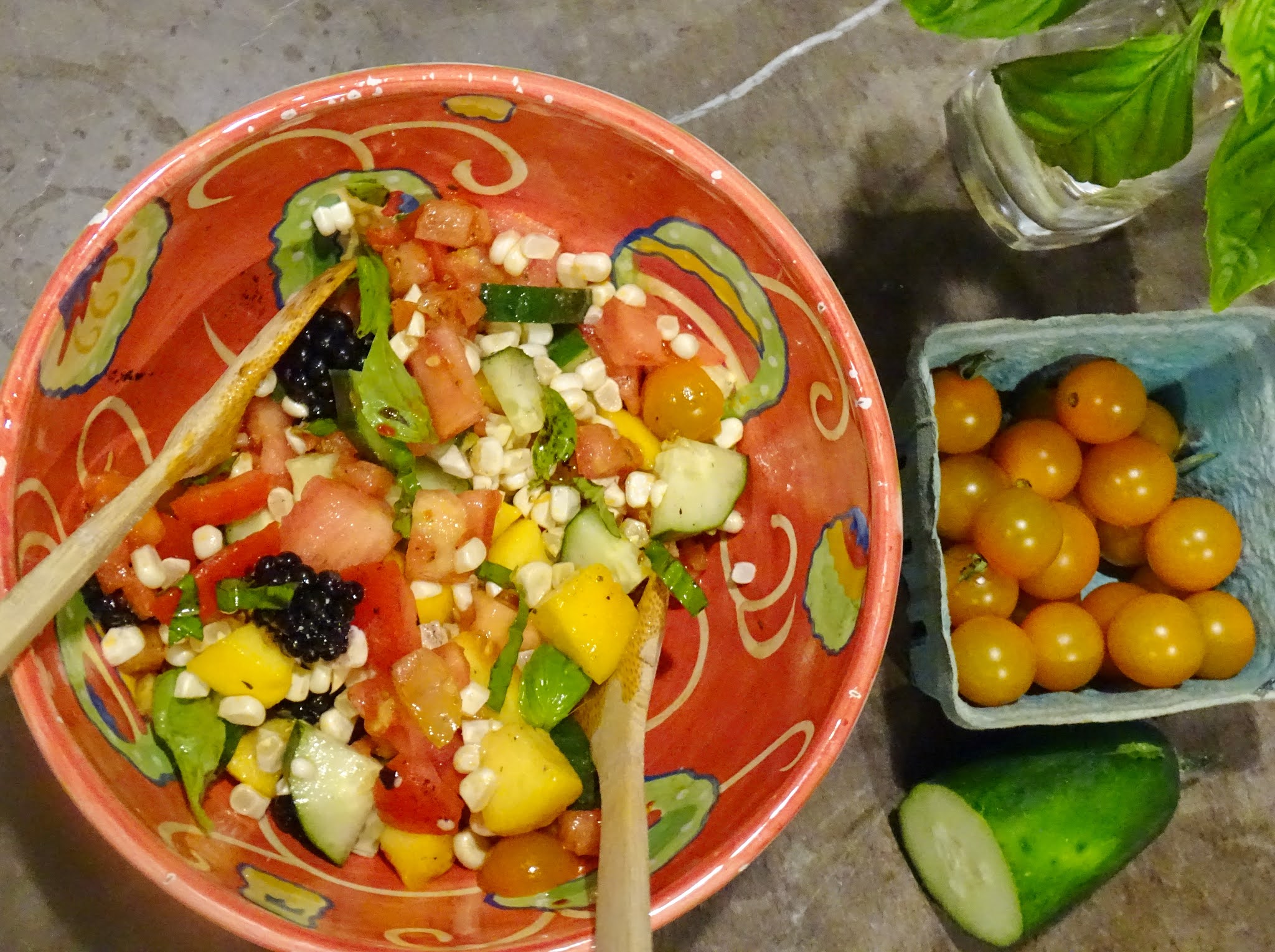
And what has the Kitchen Goddess done with her peaches? Frankly, almost everything. For starters, she has a sliced peach with yogurt and a teaspoon of honey every morning for breakfast. (Yes, every morning for at least the past month. You’d think it would get boring, but no.) For lunch and dinner, there’s the unbeatable summer salad combo of diced peaches, juicy beefsteak tomatoes, and sweet uncooked corn cut from the cob. Dessert brings a scoop of peach sorbet or frozen peach yogurt, or perhaps a slice of rustic peach tart with whipped cream or vanilla ice cream. And if you are feeling adventuresome,  try pickled peaches. (More on those later.) I  haven’t yet made peach jam, but just wait... 

Here's one of those salads – no recipe, just grab a little of everything you got at the farmers’ market, and toss them with some Honey-Lemon Vinaigrette.


In past posts, I’ve written about Eggless Peach Ice Cream (Click for link.)


and Frozen Peach Yogurt.(Click for link.)


But, you know, you can never really get enough of frozen peach desserts. So this time, I’m telling you about Peach Sorbet, because if you have an ice cream machine, it is falling-off-the-log easy.

Now on the subject of ice cream, let me digress momentarily to tell you about my latest find: Sumo ice cream containers. Dishwasher safe, nonstick interior, and double-wall insulation resists freezer burn and keeps ice cream/sorbet cold and firm, without reaching ice-cube hard. And the shape makes scooping super easy. It’s $14.99 on amazon.com – and yes, I paid full price for mine. The Sumo Kitchenware company is blissfully unaware of the Kitchen Goddess. Their loss.


Making sorbet is so easy; the critical elements are the quality of the fruit – which should be as good as you can find – and the type of fruit, as fruits high in pectin (berries, stone fruit, and grapes) or fiber (mangoes, pears, and bananas) are viscous and full of body, and make for an especially creamy sorbet. The food- and travel-writer Max Falkowitz has written in depth on the Serious Eats website (seriouseats.com) about sorbet and ice cream. The Kitchen Goddess has made her share of sorbet that became bricklike in the freezer, so she was especially happy to read Max’s suggestion to include a bit of corn syrup to improve the viscosity of the sorbet. It works.


Peach Sorbet

Adapted from Max Falkowitz at Serious Eats (seriouseats.com)


Makes 1½ quarts.

Ingredients
3 pounds fresh or frozen peaches (about 8 whole), peeled and diced*
2 teaspoons freshly squeezed juice from 1 lime
1 cup sugar
¼ teaspoon kosher salt
1 tablespoon corn syrup
1 tablespoon ginger liqueur

Special equipment: blender or food processor, and ice cream maker

*Kitchen Goddess note on process: Max prefers to purée his peaches with the skins on, then run the purée through a fine-mesh strainer. The Kitchen Goddess thinks that straining peach purée is tedious and boring, so she peels her peaches before puréeing. You can choose your own m.o., which can even include not peeling and not straining, as long as you don’t mind little bits of skin in your sorbet.

Directions
Purée the peaches in a blender or food processor with the lime juice and sugar until the sugar is fully dissolved and the mixture is a smoothness to your liking. (Some folks do like lumps of peach in their sorbet.) Add the remaining ingredients and blend briefly. Taste and add more salt if the purée seems bland. (Extra salt can help the peach flavor pop, so add ¼ teaspoon and taste.)

Chill the purée for 2-3 hours, then process in your ice cream maker according to manufacturer’s instructions. Store in the freezer for a couple of hours before serving.


* * *

For my peach tart, I thought I’d hew to a sort of farm-stand flavor by using whole wheat flour in the pastry. It has a mild nuttiness that reads almost sweet, and plays well off the lightly tart taste of the peaches. The Kitchen Goddess added the pistachios for texture; and because she is a bit of a purist about the taste of peaches, she refused to contaminate them with the ginger or cinnamon that some recipes include. Feel free to add a half-teaspoon of either spice if you wish.

Kitchen Goddess note about the fruit: Peaches tend to get brown once they’ve been peeled. So these directions have you peeling/slicing the peaches after the dough is rolled out and ready. If you prefer, you can peel/slice your peaches while the dough is chilling; if you do, add the peeled fruit to a bowl of cold water with lemon juice to keep them looking fresh.


Rustic Peach Tart


Serves 8.

Ingredients

For the pastry:
120 grams (1 level cup) all-purpose flour, plus extra for dusting
113 grams (slightly less than 1 cup) whole wheat flour 
1 teaspoon kosher salt
1 tablespoon sugar
½ cup (1 stick) unsalted butter, cut into tablespoons, each tablespoon cut into fourths, then chilled well
¼ cup Crisco, cut into 5-6 bits and chilled
1 tablespoon apple cider vinegar, chilled
1 tablespoon vodka, chilled
3 tablespoons cold water

For the filling:
¼ cup pistachios, coarsely chopped
2-3 tablespoons milk or cream
2-3 tablespoons Turbinado sugar
5-6 ripe peaches, peeled, halved, and cut into wedges about ½-inch thick

Kitchen Goddess note: Turbinado sugar is a coarse-grained sugar that has been only partially refined to retain some of the original molasses from the sugarcane. As such, it has a subtle caramel flavor. Sugar in the Raw is the best-known brand of turbinado sugar, and most grocers carry at least one other brand, including bulk. You can make your own – as I did for this tart – from equal parts white sugar and dark brown sugar, but the Kitchen Goddess prefers the coarse-grained look of the real thing on the crust. She’s such a perfectionist.

Directions
First make the pastry. Put the flours, salt and sugar in the bowl of a food processor. Pulse 4-5 times to mix the ingredients and add air to the flours. Distribute the cold butter and Crisco evenly on top, and pulse another 12-15 times until the fats are well distributed, with some pea-sized chunks scattered here and there in the mix. The texture should resemble coarse sand.

Combine the vinegar, vodka, and water, and sprinkle it around the flour/fat mixture. Pulse just until the mixture begins to hold together in a clump, 15-20 pulses. (If necessary, you can add another tablespoon of water, but I have not had to so far.)

Gather and press the dough into a ball, kneading it as little as possible but making sure no dry spots appear. Form the dough into a disk about 6 inches across, wrap well in cellophane wrap, and chill at least 1 hour (up to overnight).

Once the dough is thoroughly chilled, roll it out on a floured piece of baker’s parchment to an 11-inch circle, ⅛-inch thick. Use extra flour as necessary to keep it from sticking to the rolling pin or the parchment. Trim off and discard any straggly bits of the dough and transfer – carefully! – the parchment/pastry to a large, rimmed baking sheet. Refrigerate the pastry circle for 10-20 minutes.

Kitchen Goddess note on rolling the pastry: That KG gets all bent out of shape even with a rustic tart, if the pastry isn’t a near-perfect circle. If you are similarly afflicted, here’s the KG solution: Use a pencil or black Sharpie to trace the circumference of an 11-inch pan onto a piece of baker’s parchment. Turn the parchment over. Voilà – you have a see-through pattern for your rustic tart dough, without fear of ink/pencil on the food.

Preheat the oven to 375º.

Starting about 1½ inches in from the perimeter of the round, arrange the peach segments in concentric circles until you reach the center.


Sprinkle the pistachios over the peaches all the way to the edge. Do the same with the sugar, reserving a couple of teaspoons of sugar for the part of the crust that gets folded over.

Fold the outer rim of dough over the peaches, pleating it in overlapping folds as you move around the circle. Brush the pastry border with the milk or cream (to help the crust brown), and sprinkle the border with the remaining Turbinado sugar. Bake 45-50 minutes, or until the outer crust is golden.

Let the tart cool in the pan on a wire rack. Cut into wedges and serve with ice cream or whipped cream.

So stay cool and have dessert first!


Wednesday, September 9, 2015

For Your Post-Labor Day Celebrations
What’s cooking? Summer Fruit Rosé Sangria


The Kitchen Goddess has worked herself into what in the South we call a “tizzy” over this post. It was supposed to be short and easy – a simple sangria for the Labor Day celebration. And now of course, Labor Day is over, but do not tell me you can’t find a way to celebrate something. The weekend? The still-warm weather? The start of football season?

Back to the sangria, the KG found herself overwhelmed with choices. For starters, which wine? Red felt too hot. White? Well, the KG had already posted her favorite white sangria, which you’ll find here. That left rosé. Over the years, rosé has unfairly gotten a reputation for being a sweet wine, but there are literally hundreds of really nice, dry rosé wines, and many are very nicely priced for this purpose. So that’s what we’re going to use today.

A tiny tidbit of trivia: According to Wikipedia, rosé may actually be the oldest type of wine. Evidence of winemaking goes back as far as 8000 years ago, in ancient Georgia (the country, not the state, though my friends in the state may claim to have been drinking that long). As I understand it, the earliest methods left the skins in contact with the juice for up to 3 days. And that, my friends, is how you make rosé.

So you have the wine, and now you have to add something. Again, too many choices. Your basic sangria contains wine, fruit, and some type of liqueur (most often Triple Sec or Cointreau). Beyond those, I found any number of other liquids in what the authors called “sangria”: rum, gin, port, brandy, various fruit juices, and simple syrup. Some also threw in cinnamon sticks, mint, or citrus rinds to enhance the flavor. Finally, some recipes added sparkling water at the end. The mind reeled...

I did find an interesting recipe – which I’ll share here – but once I made it, my hubby pronounced it “too alcoholic.” Hrmph. Probably because of the gin. I’ve tasted it today – after giving it a night in the fridge – and it’s really quite good; but there is the gin. Even after adding a bit of sparkling water, the Kitchen Goddess noticed a kick. So if you think you’d prefer a version that won’t have your friends falling asleep on your couch, I’ve come up with another, simpler concoction with more fruit and no gin.

First, the recipe with gin. I’ve already modified it because it called for Campari, which I don’t like. And the mixologist serves it with fruit juice ice cubes, which I found to be a little too precious – also too much work.

Kitchen Goddess note: Both of these recipes call for simple syrup. In fact, many cocktails and most sangrias call for simple syrup. It’s so simple, you should just keep some in your fridge. It’s also useful for sweetening iced tea or lemonade – no need for extended stirring to get the sugar to dissolve. To make simple syrup, combine equal parts sugar with cold water (measuring by volume, which is reasonably accurate, you want ½ cup sugar to ½ cup water, or 1 cup sugar to 1 cup water, etc.) in a small saucepan. Set over medium-high heat and stir just until the sugar dissolves. When the mixture reaches a simmer, turn off the heat and set the pan aside. Pour the mixture into a sterile jar and it will keep in the fridge for at least a month. (Remember, sugar is used as a preservative, so if your jar is clean, it should keep indefinitely.)


Rosé Sangria


Adapted from Troy Sidle, a bartender and bar designer based in New York City, as seen on the food site, TastingTable.com.

Serves 6.

½ cup gin
3 tablespoons St. Germain liqueur (or Campari, if you prefer)
8 slices of peel from a grapefruit, 1 inch wide and 2-3 inches long (use a vegetable peeler)
8 slices of peel from a lemon, same as above
½ cup raspberries
1½ cups strawberries, hulled – ½ cup quartered and 1 cup sliced into rounds
2 tablespoons simple syrup
1 bottle dry rosé wine (750 ml)
1 nectarine, thinly sliced
Sparkling water
Garnish: mint sprigs

In a small bowl, stir the raspberries, the quartered strawberries and the citrus peels into the gin and the St. Germain. Muddle (crush) the berries to add their juices into the other liquid. Refrigerate at least 2 hours or overnight.

Once the fruit-infused gin mixture has had time to mellow, strain out the berries and peels and add the remaining liquid to a large pitcher along with the 2 tablespoons of simple syrup and the wine. Cover with cellophane wrap and allow the ingredients to get to know each other overnight in the fridge. Stir in the sliced strawberries and the nectarine. Serve over ice with a splash of sparkling water.


Kitchen Goddess note: The above mixture is relatively high in alcoholic content, so you may want to suggest that your guests treat it as a cocktail instead of a wine punch, drinking sparingly. Alternatively, you can go with the following, which is fruity and refreshing, yet lower in alcohol.


Summer Fruit Rosé Sangria


Serves 6.

1 ripe peach, peeled and diced
1 teaspoon juice and 8 slices of peel (about 1 inch wide, 2-3 inches long) from 1 Meyer lemon
2 tablespoons St. Germain liqueur
2 tablespoons simple syrup
1 bottle dry rosé wine (750 ml)
1 sliced nectarine
½ cup sliced strawberries (hull removed)
Garnish: mint sprigs

In a small bowl, muddle together the peach, the lemon juice and the peel with the St. Germain liqueur, and set aside for 2-3 hours.

Separate the lemon peels and reserve, then strain the muddled peach from the liqueur. (There’s no further use for the peach, but I’m sure you can find something to do with it. It’s quite yummy.)  In a large pitcher, stir together the simple syrup, the wine, and the peach-infused liqueur. Add the peels to the wine mixture, along with the nectarine slices and the strawberries. Refrigerate 2-3 hours and serve over ice with mint garnish.


The Wines

I used two wines for these concoctions, one from Italy and one from France. The first was a rosato from Tuscany, Salcheto’s 2014 Obvius.


 The second was a 2014 Cœur Estérelle Côtes de Provence rosé. Both were dry and somewhat fruity; both cost less than $14.


And now the KG is off to enjoy the fruits – and spirits – of her labors. Happy Wednesday, all!

Sunday, August 24, 2014

It’s a Summer Feeding Frenzy
What’s cooking? Roasted Tomato-Peach Spread


“You should live on a farm,” my husband said as he surveyed the 4 pounds of tomatoes, 6 pounds of peaches, 2 pounds of sugar plums, and 6 pints of ground cherries I brought home from the farmers’ market this week. Plus assorted veggies. Thoughts of myself riding a tractor or up at dawn feeding the chickens swirled in my brain. On a farm with these fingernails? Not a chance.

And he doesn’t know the half of it. In the past month, I’ve given a new twist to my farmers’ market regimen: I now carry a supply of fruits and veggies, and maybe some fish, down to my son and his girlfriend in New Brunswick. They’re both new docs in a residency program, with virtually no time for grocery shopping. Then out of fairness to the other son, I drive a bundle of the same to him and his wife in Scotch Plains. I am reminded of one time before they married, when they stopped by on a Sunday and I loaded them up with various extras from my farmers’ market purchases. She turned to him on their way out the door and said, “You know, we should shop here more often.”

I love feeding my family; I’ve felt responsible for their palates since they were born, and I want them to enjoy the great fruits and veggies that are available. And if that means driving an embarrassing number of miles on summer Sundays, ...well, then, that’s what I’ll do. We all have our weaknesses; mine seems to be local produce.

August is really the month that NJ foodies – and the Kitchen Goddess claims both Austin and New Jersey as the sources of her obsession – go wild. The confluence of corn, tomato, and peach harvests is enough to send us into a frenzy.


For me, one way to fully appreciate this dynamite trio is to pile them all together in a salad. Add some of the ultrafresh, crisp and sweet lettuce that’s been available all summer, and an herbed vinaigrette, and you have the main element of a great summer lunch. Sprinkle some sliced almonds or add some wedges of chewy ciabatta bread and an assortment of cheeses, and you really need nothing more. For this particular salad – today’s lunch – I also diced up an avocado.


But what I really want to tell you about is a delightfully chunky, sweet-savory jam I discovered last year. Now before you decide you don’t need another jam, note that this one was designed to work as an appetizer – not a breakfast accompaniment, though I’d be happy to slather it on my toast. In fact, you’ll note that I don’t even call it a jam, because it’s really much more. Roasting the fruits (remember: tomatoes are a fruit) gives this condiment a much more nuanced flavor than any saucepan jam; the onions and roasted garlic take it over the top.

The original recipe was developed by a University of Toronto student, Lauren Classen. Ms. Classen won first place with it in some Toronto-based contest, in the appetizer category.

So how can you use it?


■ My favorite way is to serve it as an appetizer. Spread fresh ricotta or goat cheese on top of toasted baguette slices, then top each with a dollop of tomato-peach spread.

■ Apparently, Ms. Classen serves it also as the filling in mini-tarts. I haven’t tried that but will update you when I do.

■ Serve it as the condiment on sandwiches or sliders of sliced pork or chicken. It’ll work well with your Thanksgiving turkey, but to have it in November, you’ll have to preserve it in jars.

Kitchen Goddess note: Preserving is soooo easy. Basically, you just sterilize the jars, fill them with whatever, and submerge them in boiling water for 5 minutes. That wax your grandmother used has gone the way of manual typewriters and rotary dial telephones. More detailed steps to preserving are at this link. 

What the Kitchen Goddess really likes about this recipe is that it uses the oven. No candy thermometer or stovetop guesswork as to when it’s “jam.” And no pectin. The Kitchen Goddess is still trying to figure out pectin.


Roasted Tomato & Peach Spread

Adapted from Lauren Claussen in the Toronto Star

Yield: one quart+, or enough for 6 half-pint Mason jars, filled to a half-inch below the rim.

4 pounds ripe tomatoes, cored and halved horizontally
2 pounds ripe peaches, skins on, pitted and cut into chunks about the size of ½-inch dice
1 medium sweet onion, in ½-inch dice
4 large cloves roasted garlic, mashed to a paste
2 teaspoons sugar
¼ cup olive oil
1 teaspoon kosher salt, or to taste
2 tbsp dried oregano

Preheat the oven to 400º.

Spray a very light coating of oil on a large, rimmed baking sheet. Arrange the tomato halves along the perimeter of the pan. Stir together the peaches, onions, and garlic, and pile them in the center of the pan.

Sprinkle the sugar on the tomatoes, and drizzle the oil over everything. Sprinkle the salt and oregano over everything.


Roast the fruits in the oven for 40 minutes; you’ll notice that the onions and peaches will start to brown on their edges. Remove the pan from the oven and, using a potato masher or some similar instrument (spatula, large spoon), mash the tomatoes to nearly flat, to release the juices. Then, using a spatula or large spoon, mix the peaches, onions, and tomatoes together.


Return the pan to the oven and bake, stirring every 15 minutes, until the tomato juices have pretty much evaporated, and the mixture attains the consistency of thick jam, which will take about 1 hour and 15 minutes.


Kitchen Goddess note: If you have roasted the fruits for the full hour and 15 minutes and it still looks very soupy, spoon off some of the juice into a glass and enjoy it. Then return the pan to the oven for a final 15 minutes. If it’s still very liquid looking, let it sit on top of the stove (no heat), lightly covered, overnight.

Adjust salt or sugar seasoning to taste.

Serve warm or cold. Refrigerate for as long as a week, or freeze, or preserve in Mason jars.


Wednesday, July 31, 2013

Keeping My Cool
What’s cooking? Apricot Sorbet and Peach Frozen Yogurt

Normally, the idea that a giant hotel will, in 6 months time, be blocking part of the view from our condo would be enough to send a person into a deep funk.


The news was worrisome, mostly because it threatened our view of the Statue of Liberty. But in life, I try not to worry about events over which I have no control. I’m not sure it’s saved me any gray hairs, but it certainly reduces the number of things I worry about. So I’ve determined to make whatever lemonade I can out of this little lemon.


Mostly, it’s been really fun this summer watching the crews of construction workers pouring and smoothing foundations, installing windows, framing out rooms, and so on. Last week, when the weather was ghastly and I didn’t want to go out, the ever-changing panorama of workmen and cranes and those elevators that go on the outside of the building was a lot more fun than daytime TV.

The heat outside also encouraged me to generate more cool inside – with sorbets and frozen yogurts. With any fruit I can get my mitts on. OMG. Each flavor seems better than the last. So if you don’t have an ice cream maker, I heartily recommend one. Try one of these, all adapted from David Lebovitz’s The Perfect Scoop.

But first, a couple of the Kitchen Goddess’s notes about sorbets/frozen yogurts:

1. These recipes call for cooking the fruit in a non-reactive saucepan. Generally, that means anodized aluminum, glass (e.g., Pyrex), enamel-coated cast iron (e.g., Le Creuset), or stainless steel. Highly acidic foods – most fruits (including tomatoes), wine, and vinegars – react badly with aluminum and untreated cast iron, causing a metallic taste to leach into the food, changes in the color of the food, and pits/discoloration in the pan itself. Aren’t you glad you asked? You can use a copper pan, but only if you’re cooking fruit WITH sugar. Me, I just go with the stainless steel pans.

2. My friends at America’s Test Kitchen recommend “super-chilling” your dessert base by freezing a small amount (~½ cup) of it, then remixing it into the larger part  before transferring it to your ice cream machine. That seems to be effective in producing a less granular dessert.


Apricot Sorbet


Makes about 1 quart.

2 pounds really ripe apricots, pits removed
1 cup water
1 cup sugar
1 tablespoon Domaine de Canton ginger liqueur

Kitchen Goddess note: The ginger liqueur was my own idea. Or you can just add a piece of fresh ginger to the stovetop mixture. But if you get the ginger liqueur, your life will never be the same. Lebovitz added almond extract instead, which doesn’t sound nearly as exciting.

Chop the pitted apricots into eighths. (Don’t obsess on precise eighths – it’s all just going into a stew.) Bring the apricots and water over medium heat in a non-reactive pan, covered, until cooked through (about 10 minutes). Stir occasionally. When the fruit is completely softened, remove it from the heat and stir in the sugar. Let cool to room temperature.

Purée the mixture in a blender until smooth, about 3 minutes. Add the ginger liqueur. Chill thoroughly, then process in your ice cream maker according to the manufacturer’s instructions.

* * *


Peach Frozen Yogurt


Makes about 1 quart.

1½ pounds ripe peaches (about 5 large peaches)
½ cup water
¾ cup sugar
1 cup Greek yogurt (whole-milk, 2%, or fat-free – I used fat-free which makes the sorbet a bit harder to scoop straight out of the fridge, so I let it thaw 12-15 minutes first)
1 teaspoon fresh lemon juice

Peel and pit the peaches, then cut them into chunks. Put them with the water into a non-reactive saucepan and cook over medium heat – low simmer – until soft (they’ll start to look like canned peaches), about 12 minutes. Turn off the heat and stir in the sugar. Refrigerate until well chilled.

Purée the chilled fruit in a blender with the lemon juice and the yogurt. Depending on your preference, you may want to leave the purée slightly chunky; smooth or slightly chunky won’t matter to the flavor.

Process in your ice cream machine according to manufacturer’s directions.

Kitchen Goddess note: In a moment of what can only be described as inspiration, the Kitchen Goddess spooned on some of that fabulous Blueberry Syrup from an earlier post. OMG.


P.S. It turns out we’ll still have the best parts of our view, including Lady Liberty.

Monday, September 24, 2012

Summer’s Over but Salad Season Is Still Going Strong
What’s cooking? Poppy Seed Dressing


It’s been a salad-y week for me. I’m in Texas getting ready to spend 10 days in Italy, so you may not hear from me for a while. And in an effort to shed a few of the pounds that will no doubt reappear over these coming 10 days, I’ve been experimenting with just about every combination of salad ingredients available. But I haven’t lost any weight in the process. It must have been the ice cream I had for dessert.

As the weather gets a bit cooler, there’s a resurgence of lovely types of greens that don’t really like the heat of August. And you can still find wonderful, fresh salad items like tomatoes and figs and blackberries. I read somewhere that a new type of sprout – from sunflower seeds – is the latest rage among professional chefs, so I pounced on that, too, when it showed up at my local Whole Foods.